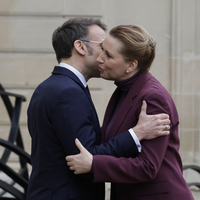


PARIS (CN) - Leaders from France, Denmark and Greenland met in Paris Wednesday to reaffirm the importance of territorial integrity, security in the Arctic and democracy as a whole - a week after U.S. President Donald Trump backed off threats to seize Greenland.
"In a situation where the world order as we've known it is under pressure, changing rapidly - maybe it's gone - we need a stronger Europe than ever," Danish Prime Minister Mette Frederiksen declared.
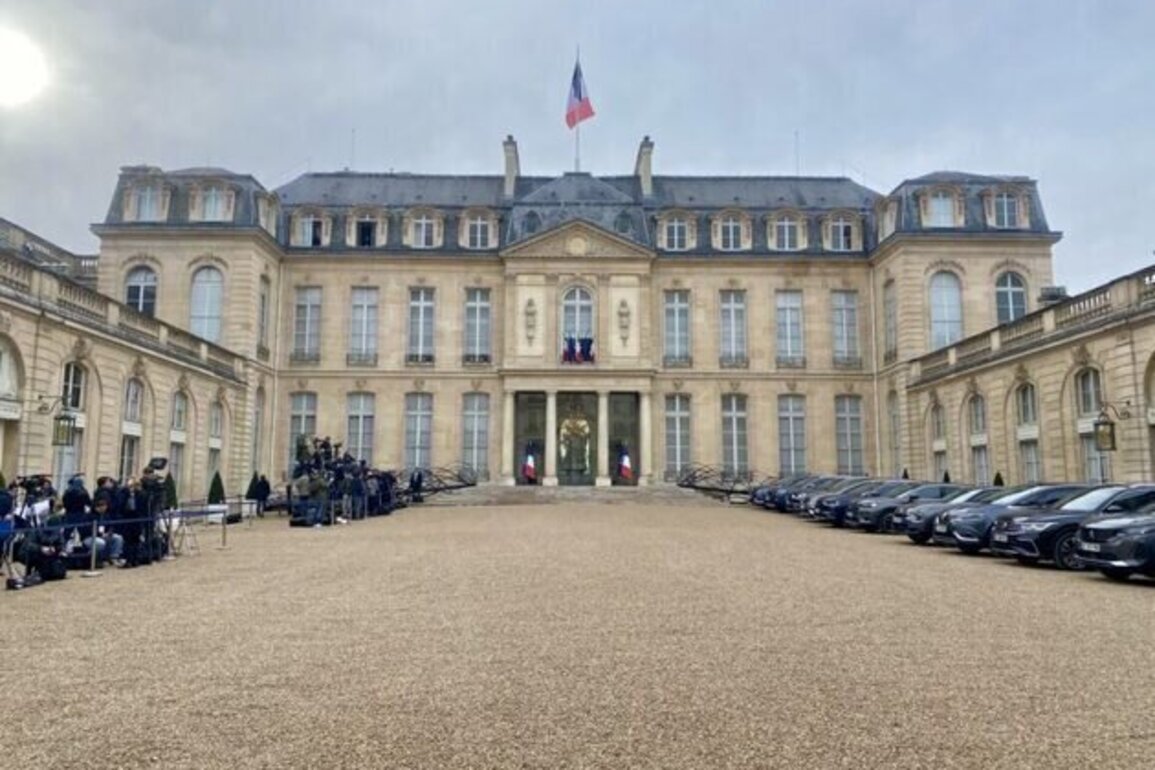
Under the tricolored skylight of the Elysee Palace, Frederiksen stood alongside Greenland's Prime Minister Jens-Frederik Nielsen and French President Emmanuel Macron. The mood was somewhat jovial. Macron spoke a few words in Greenlandic, prompting smiles and nods of approval from his counterparts.
"Greenland is not for sale, nor is it up for grabs. The Greenlanders will decide their own future," Macron said in the Indigenous Greenlandic language.
Then, he told Frederiksen in Danish that France would "be side-by-side" with the "kingdom of Denmark."
Frederiksen closed her address with a lyric from the French electronic band Daft Punk: "Work it harder, make it better, do it faster, makes us stronger."
Frederiksen thanked France multiple times for the contributions it has made to Greenland, and for "standing up for the fundamental values we share and cannot compromise."
"The three of us agree that this is a priority, and NATO must play a more active role in the Arctic region and particularly around Greenland," she said. "It simply works when you stand firm and united."
The leaders' speeches touched on the concrete - security protections for Greenland - and existential, like safeguarding democratic values.
But they did not address the elephant in the room: Trump, whose recent threats to acquire the world's largest island were the impetus for this meeting. In recent weeks, Greenland's sovereignty, NATO and the global world order seemed to be in jeopardy, but there were no direct references to the U.S. on Wednesday.
"Given Russia's position in the far north, China's economic presence, and the strategic consequences of this rapprochement, we agree on the need to strengthen our defense posture in the Arctic," Macron said.
Trump had partially framed his desire for Greenland as a security measure, according to Hall Gardner, professor of politics at The American University of Paris.
"Trump is nevertheless seeking to acquire U.S. geostrategic positioning in Greenland to counter Russian and Chinese challenges to control the Arctic area and its resources," Gardner said. "And he wants to assert U.S. corporate control over Greenland's vast resources, including rare earth elements, to help pay for U.S. defense expenditure, while Trump and his associates hope to profit as well."
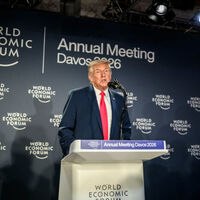
However, Trump abruptly appeared to soften his stance on Jan. 21, when he said the U.S. would not take Greenland "by force" during his speech at the World Economic Forum in Davos, Switzerland.
Abishur Prakash, a geopolitical strategist at The Geopolitical Business Inc., said European leaders probably did not want to "tip the boat" by mentioning it.
"America has gone quiet about 'needing to have Greenland,'" he said. "Nobody wants the old threats to return because the reality is, there is little Europe can do to dissuade Trump - the goal is to set a new strategic direction and move under the cover of the new agreement."
After his speech, Trump spoke of having "the framework of a deal" for the U.S. to gain access to Greenland, though NATO chief Mark Rutte insists he did not negotiate on behalf of Denmark or the semiautonomous territory. Details were still unclear this week, even to leaders in Denmark and Greenland.
It's unclear why exactly Trump took a step back. Maxime Lefebvre, a diplomat and professor of international relations at the ESCP business school, said while Trump was likely deterred amid the U.S. "domestic context" and reaction of financial markets, Europe probably played a role.
"There was a good combination between countries showing firmness, like France, and countries and leaders keen to deescalate (like Germany, Italy and European Commission)," he explained. "The European Parliament also postponed the approval of the trade deal between the European Commission and the U.S. after Trump's new tariffs threats, and the European Commission has prepared some trade retaliations in the case of new tariffs."
Nonetheless, Macron said "recent events" confirm "the situation in Greenland is a wake-up call for Europe," and France would be strengthening its relationship with "Denmark and Greenland in particular."
Lefebvre said Macron was initially skeptical that Trump was serious about obtaining the territory. However, when the U.S. declarations became more threatening, Macron quickly changed his stance and France became one of the firmest countries in Europe on the issue.
"He sent a couple of soldiers to Greenland, and he proposed the activation of the EU's anticoercion instrument against the U.S., which has never been used since it has been approved," Lefebvre explained. "He also tried to organize a G7 meeting, that France is chairing in [June] 2026, in order to find a solution - and he was the most targeted leader by Donald Trump at Davos."
France will open its new consulate in Greenland's capital, Nuuk, on Feb. 6, which its foreign minister Jean-Nol Barrot has previously called a "political signal." And the Charles de Gaulle, the French Navy's flagship aircraft carrier, is on its way to participate in a "large-scale joint and allied exercise," according to the French defense ministry.
In Prakash's view, the Western order is at its weakest point since World War II and the alliances, systems and institutions that define the West, and the world, are destabilized by Trump's "America First" policy.
"The U.S. threat to annex Greenland would break whatever remains as it would permanently shift the European outlook of America from friend to foe," he said. "This is not about Greenland per se, but what the annexation of Greenland would represent - a complete disregard for European sovereignty and the rules-based order."
Nielsen's address was just a few sentences long, but the message was clear. After briefly touching on the opportunity for new business ventures, he addressed what's at stake beyond the territory itself.
"Our close cooperation in this situation is not only about Greenland, it goes beyond; it's about our values, democracy, respect for law and order and integrity," Nielson said. "It's time for unity, not division."
Source: Courthouse News Service